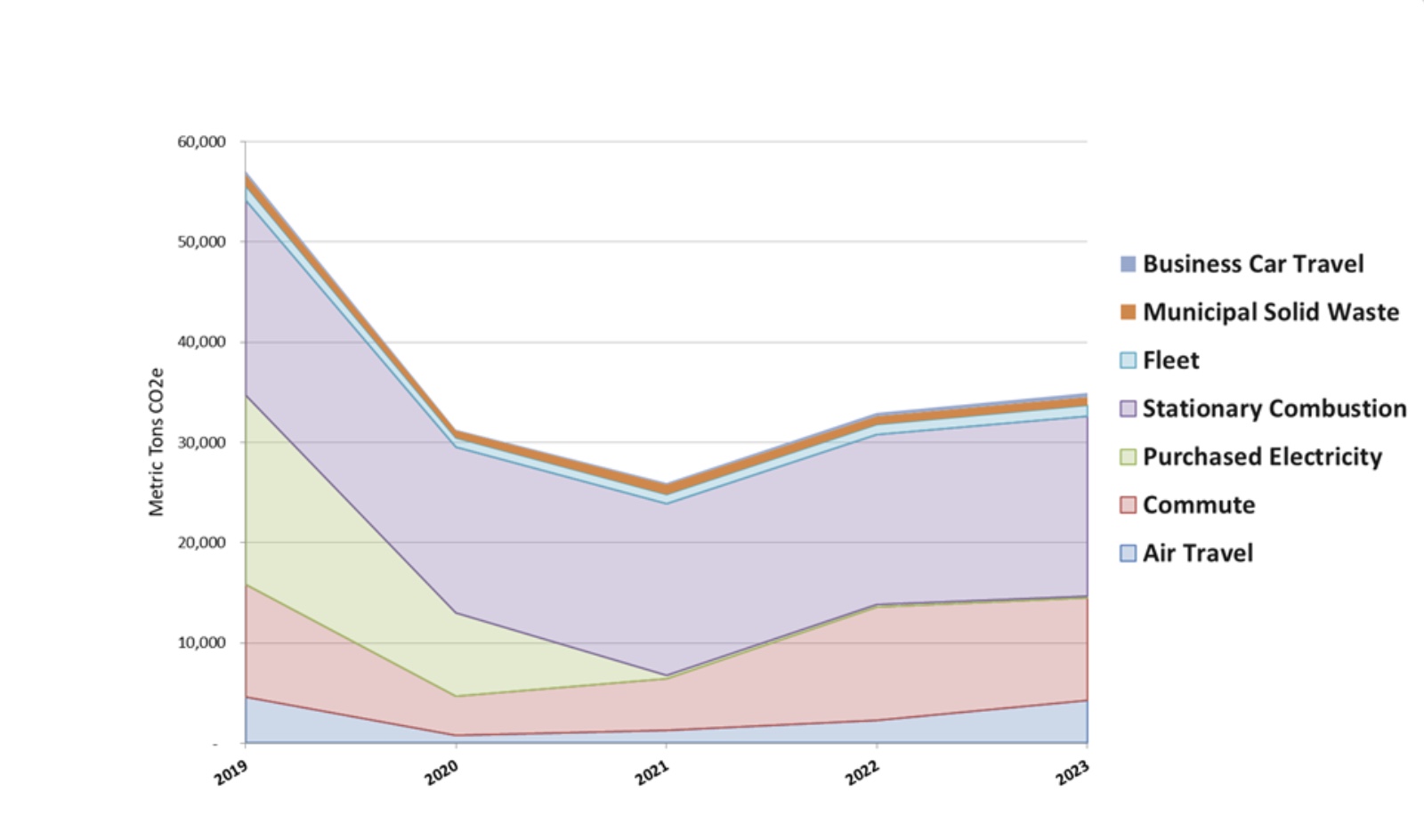
The 2025 CAP assesses and analyzes UCSB’s current, historical, and projected emissions and evaluates the campus’s progress toward meeting the UC Climate Policy. Planned and conceptual climate change mitigation strategies are outlined in the plan and provide a potential pathway towards achieving the 90% reduction in total emissions (Scopes 1, 2, and 3 shown in the figure) by calendar year 2045 from a 2019 baseline. The plan also addresses climate resilience and how we can prepare our campus community for future climate conditions.

Significant Achievement:
Total greenhouse gas (GHG) emissions have already fallen by over 40% relative to the 2019 baseline.
Plan Objective: 90% direct reduction in total emissions (Scopes 1, 2, and 3) by 2045.
Current Status: The Largest remaining sources are stationary combustion (natural gas) at 51% and commuting at 29%.
Decarbonizing the Campus (Scope 1)
Central Utility Plant (CUP): Transition from distributed natural gas boilers to an all-electric CUP featuring Air-Source Heat Pumps and Thermal Storage. Based on the Clean Energy Master Plan and would eliminate nearly all direct emissions. If completed, UCSB will be one of the first (perhaps THE first) public higher education institutions to eliminate greenhouse gas emissions from on-site combustion.

Embedding decarbonization in campus decision-making:
- UCSB adopted a “Decarbonization Policy-Scope 1 Emissions. The policy states that “new buildings or major renovation projects must not use onsite fossil fuel combustion.”
- Campus Planning Committee (CPC) engaged. In the future, all DPP reports must describe to CPC how campus projects comply with the campus Scope 1 Decarbonization policy.
- Detailed Project Program (DPP) for C·CHANGE Siting and sizing for all-electric central plant and phased expansion of hot water loop.
- Next Steps - Advocacy, support, and financing will be needed - $16M for design phase
Scope 2 - Purchased Electricity
Clean Electricity - Scope 2 emissions from purchased electricity decreased ~20,000 MT CO2e in 2019 to ~200 metric tons. Approximately 99% of the electricity purchased is now carbon-free, 6.2 megawatts of on-site solar energy, which provides approximately 15% of UCSB’s electrical demand.
Energy Efficiency - Completed more than 100 energy efficiency projects in the last 10 years, saving the campus $1.25M annually and reducing GHG emissions by over 500 MT CO2e. Energy Efficiency remains a key strategy for reducing energy use and costs, and externalities associated with energy production.

Sustainable Transportation (Scope 3)
~29% of UCSB’s GHG emissions come from commuting, down 9% from our 2019 baseline
The Transportation Alternative Program (TAP) offers discounts on discounted Bus passes (locally and long-distance), discounted carpool parking permits, access to bike lockers, free parking passes, and an emergency ride home program, and subsidizes vanpool services. UC Santa Barbara also continues to expand campus housing; it is estimated that San Benito and the East Campus project will reduce GHG emissions by ~1,800 MT CO2e annually. We are also greening the commuter fleet. ZEV ownership among UCSB Faculty, Staff, and students has grown by ~30% since 2019. Installed 105 charging ports; secured funding to install 28 more ports by January 2027 through the E-CAR 805 project. Also partnering with local governments to support the installation of ports throughout San Luis Obispo, Santa Barbara, and Ventura Counties. Below are strategies recommended in the plan to further reduce GHG emissions.
Enhance Long-Distance Bus Service - Increase subsidies and advocate for improved service for The Clean Air Express (serving Santa Maria, Lompoc, and Buellton to Goleta) and the Coastal Express (operated by VCTC/VISTA) connecting Oxnard/Ventura and UCSB.
Expand Vanpool Service - UCSB’s Vanpool Program currently accommodates fifty-four employees commuting from Santa Maria, Buellton, Santa Ynez, Solvang, Lompoc, and Ventura.
Evaluate Increasing Local MTD Bus Subsidies - The current monthly expense for an annual staff parking permit is $37.50. The subsidized MTD bus pass is presently $59 per month via pre-tax payroll deduction (compared to the full cost of $80 per month).
Encourage Remote/Flexible Work and Online Classes - Commuting emissions are down 9% since 2019, primarily due to an increase in remote work (Faculty/Staff remote work jumped from 4% in 2019 to 25% in 2024).
Consider forming a Transportation and Commuting Advisory Board to explore Restructuring Parking Fees. UCSB has the lowest parking prices in the UC System; long-term commuter parking permits have only increased by $2.50 per month over the last 20 years. Subsidized monthly bus passes now cost more than campus parking permits.
Bonnie Reiss Climate Action Fellows developed 23 potential strategies for reducing commuter information, not all of which were included in the plan. You can learn more here.

Business Travel (Scope 3)
Accounts for ~13% of UCSB’s GHG emissions, down 6% from the 2019 baseline.
UC System-Wide Strategies for Reducing Business Travel Emissions
- Providing more accurate data to track business travel emissions
- Working with travel suppliers, including airlines, to increase their commitment to providing more sustainable low-carbon travel options.
- The Global Climate Leadership Council sprint on Business travel led by faculty in the summer/fall of 2026.
Potential UCSB Strategies
- UCSB Voluntary Business Travel - The Green Office program developed a Voluntary Business Travel Assessment and Guide for air travel requested by administrative staff.
- Consider limits on the Administrative Travel Program - restrictions on administrative travel for each department.
- Academic Travel Grant Alternative - The Academic Senate could form a working group to explore potential strategies for reducing GHG emissions from Academic travel.
UCSB spends an average of $975 on air travel costs per MT CO2e emitted
Municipal Solid Waste (Scope 3)
~3% of UCSB’s GHG emissions come from Municipal Solid Waste.
Current Waste Reduction Programs:
- Organics composting at all campus eating facilities, dining commons, and other outside locations
- Food recovery program run through Housing Dining and Auxiliary Enterprises (HDAE);
- Phase out of single-use plastics in food service;
- Lab Glove & Specialty Recycling Take-Back Programs
Recommendations:
- Expand take-back programs and identify product substitution opportunities for non-hazardous lab waste.
- Expanding reusable packaging programs at on-campus restaurants.
- Improve the reuse and resale of surplus equipment


Climate Resilience And Adaptation
According to the World Meteorological Organization, “the annually averaged global mean near-surface temperature for each year between 2025 and 2029 is predicted to be between 1.2°C and 1.9°C higher than the average over the years 1850-1900” (World Meteorological Organization, 2025). Even with investments in GHG mitigation efforts, climate adaptation is a necessary strategy to alleviate the effects of climate change.
With the help of several Climate Resilience fellows, input was collected from our campus community through various representative surveys, interviews, and listening sessions, and incorporated into a JEDI-Centered Climate Change Vulnerability Impact Assessment for UC Santa Barbara. This included feedback from undergraduate and graduate students, the Emergency Planning Committee, faculty, and staff on past impacts and concerns about climate hazards. UCSB is vulnerable to several hazards that may be intensified by climate change, which are not equally experienced across the multitude of diverse populations that constitute UCSB. The initial results of the JEDI-Centered Climate Change Vulnerability Impact Assessment, which looks out to the year 2055, show the greatest vulnerability to high temperatures, frequent droughts, wildfire smoke exposure, and prolonged rain events.
Projected Mitigation Strategy Reductions
|
GHG emission Scope and Source |
2019 (MTCO2e) |
2023 (MTCO2e) |
Projected Reductions (MTCO2e) |
Reduction |
|
Scope 1 - Stationary Combustion |
19,598 |
17,253 |
16,160 |
94% |
|
Scope 1 - Mobile Combustion |
1,379 |
11,48 |
846 |
78% |
|
Scope 1 - Fugitive Emissions |
281 |
323 |
0 |
0% |
|
Scope 2 - Purchased Electricity |
20,104 |
215 |
215 |
100% |
|
Scope 3 - Business Travel |
4,921 |
4,630 |
102 |
8% |
|
Scope 3 - Commuting |
11,207 |
10,195 |
9,084 |
90% |
|
Scope 3 - Waste |
1,145 |
948 |
573 |
50% |
|
Total |
58,635 |
34,712 |
26,980 |
87% |
View the Full 2025 UCSB Climate Action Plan
Plan Contributors
The campus would like to thank and acknowledge the following individuals for their involvement and contributions to the completion of the Climate Action Plan Update:
Contributing Writers:
Sustainability Internships and Community Resources Department, Student Affairs
-
Abigail Samantha Balais, UC Bonnie Reiss Leading on Climate Action Resiliency Fellow
-
Ada Chibueze, UC Bonnie Reiss Leading on Climate Action Fellow, Transportation Focus
-
Lainey Djajakusuma, UC Bonnie Reiss Leading on Climate Action Fellow, Transportation Focus
-
Katie Maynard, Director, Student Sustainability Initiatives
-
Estrella Alcaraz Munoz, Greenhouse Gas Emissions Research Intern
-
Jaret Valera, Greenhouse Gas Emissions Research Intern
-
Michelle Shteynberg, UC Bonnie Reiss Leading on Climate Engagement Fellow
Contributing Subject Matter Experts:
-
Renée Bahl, Associate Vice Chancellor, Design, Facilities & Safety Services & Co-Chair of Chancellor's Sustainability Committee
-
John Behlman, Assistant Director, Transportation Services
-
Jen Bowser, Sustainable Procurement Program Manager & Small Business Officer, Procurement Services
-
Jim Caesar, Campus Emergency Manager, Emergency Management & Mission Continuity
-
Nestor Covarrubias, Sr. Executive Director, Auxiliary Services
-
Ken Hiltner, Faculty, English Department, & Co-Chair of the Sustainability Transportation Committee
-
Jordan Sager, Associate Director, Design, Facilities & Safety Services
-
A.S Environmental Justice Alliance Members: Alicia Siebers, Katja Reinwald, Bella Rosemarie Crosland Bell
Reviewing Subject Matter Experts:
-
Dr. Mary Bucholtz, Distinguished Professor of Linguistics, UC Santa Barbara
-
Dr. Jayajit Chakraborty, Professor & Mellichamp Chair in Racial Environmental Justice, Bren School of Environmental Science & Management, UC Santa Barbara
-
Alan Grosenheider, Interim University Librarian, UC Santa Barbara
-
Dr. Julie Maldonado, Co-founder and Associate Director for the Livelihoods Knowledge Exchange Network (LiKEN), Continuing Lecturer, Environmental Studies, UC Santa Barbara
-
Shari Hammond, Associate Director, Campus Planning & Design
Review Committees:
-
Chancellor's Sustainability Committee (CSC)
-
Sustainable Transportation Committee
Administrative Services:
-
Lead Author & Project Manager - Jewel Persad, Campus Sustainability Manager